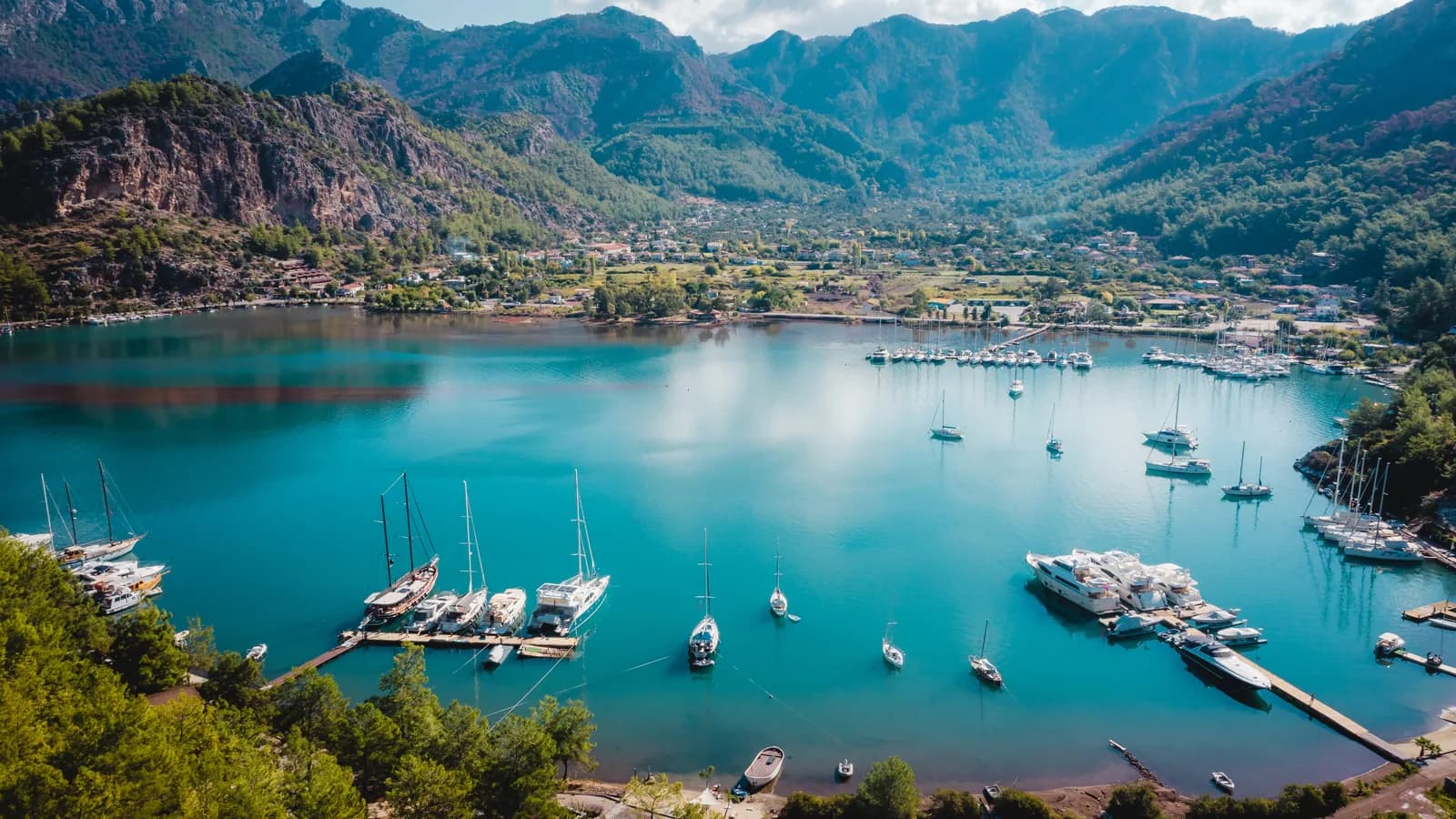
Sailing Turkey + the Greek Islands
Bodrum → Kos. Marmaris → Symi. Datça → Rhodes. Fethiye → Kastellorizo. Cross the line, sleep in two countries, and add the Dodecanese to your blue-cruise week — with captains who actually know the paperwork.
The Turkish coast and the Greek Dodecanese sit on top of each other — Kos is 20 nautical miles from Bodrum, Symi is closer to Marmaris than half the Turkish bays are. For decades the only way to do both in one trip was to land in Athens, ferry across, and watch the actual sailing happen from another boat. Cross-border charter solves that: you board in Turkey, the captain clears customs, and your week alternates between Lycian pine forests and Greek whitewashed villages.
The catch is the paperwork. Turkey requires a transit log entry. Greece requires customs clearance at the port of entry (Symi, Kos, Rhodes most common). The hull insurance has to extend into Greek waters — not all Turkish policies do. The captain has to have done it before; the first time is much harder than the tenth. That's why we don't list every Turkish vessel here. Only captains who've self-attested they've issued a transit log and carry the Greek-waters insurance extension show up below.
Cost: roughly the same as a Turkey-only week. Marina fees on the Greek side run €50–€120/night depending on the harbour, and there's a one-time Greek transit/port fee. You pay these direct to the harbour-master on arrival; the captain helps you do it.
Ce qu'il faut chercher dans le bon bateau
Filtres pré-appliqués à la sélection sailing turkey + greek islands ci-dessous.
Paperwork done right
Every captain on this page has issued a Greek transit log before — no first-time fumbling at the customs window with you watching the clock.
Greek-waters insurance
Captain self-attests the hull policy extends to Greek territorial waters. If a claim arises and the cover wasn't there, the captain is 100% liable — not you.
Best of the Dodecanese
Kos (the big island, lively + Hippocrates ruins), Kalymnos (sponge-diving + climbing), Patmos (the monastery + quiet beaches), Symi (the photogenic harbour), Rhodes (medieval city + nightlife), Kastellorizo (tiny + magical).
Plan 8 days, not 7
Greek customs clearance + Turkish transit log together eat half a day on either end. A cross-border trip works best at 8–10 days; squeezing it into 7 means trading two anchorages for paperwork queues.
No price surprises
Charter rate is the same as a Turkey-only week. You pay the Greek marina fee + port tax direct to the harbour-master on arrival — usually €50–€120/night per stop.
EU passport friendly
EU/UK passport holders need no visa to land in Greece. Non-EU guests should pre-check Schengen entry rules and bring 2 photos for the transit-log paperwork.
Bateaux présélectionnés
Voir l'annuaire complet →Itinéraires recommandés
Itinéraires les mieux adaptés à sailing turkey + greek islands.


Questions fréquentes
Pour sailing turkey + greek islands.
Can we really cross the border in a regular charter?
Yes — Turkey ↔ Greece crossings have been legal and routine for decades. What you need is (a) a captain who has cleared customs in both countries before, (b) hull insurance that covers Greek waters, and (c) 24–48 hours of paperwork prep before departure. Every vessel on this page meets the first two; the third is something we arrange when you book.
Which Greek islands can we visit from Turkey?
The Dodecanese chain — Kos, Kalymnos, Leros, Patmos, Lipsi, Symi, Tilos, Nisyros, Halki, Rhodes, Kastellorizo. The exact options depend on your departure port: Bodrum is closest to Kos / Kalymnos / Leros / Patmos, Marmaris to Symi / Rhodes, Fethiye to Kastellorizo (the smallest and easternmost Greek island, an hour from the Turkish coast).
What is a transit log?
A Turkish-government document that records when your vessel leaves Turkish waters and when it returns. The captain submits it at customs before you depart; without it, re-entering Turkey from Greece is illegal. Cost is around €30–€50; it's included in most cross-border charter fees.
Do we pay extra for Greek port fees?
Yes — Greek marina fees (€50–€120/night depending on the harbour) and a small port tax (~€10/person) are paid direct to the harbour-master on arrival. These are not included in the charter rate because they vary by route and itinerary; the captain will tell you the exact amount once your route is set.
Do we need a visa for Greece?
EU/UK passport holders: no visa, just your passport. Non-EU/non-UK passport holders: you must satisfy Schengen entry rules. Turkish-passport holders need a Schengen visa stamped before departure — captain will not depart Turkey without it.
What's the best month for a cross-border trip?
June and September. July and August are hot, busy, and the Greek harbours fill up with European yachts so berthing can be tight. May is fine but the water is still cool. October works for sailors who don't mind shorter days and the occasional weather window.
Will the captain speak Greek?
Most Turkish captains speak conversational Greek — Aegean ports have always traded with the Dodecanese, and the languages share a lot of nautical vocabulary. The Greek harbour-masters all speak English. Practical communication is never an issue.
Can we do this bareboat?
Technically yes — but only if you (the skipper) have crossed the Turkey-Greece border before AND have an international competence certificate (ICC) + the same Greek-waters insurance rider. In practice, almost all cross-border charters go crewed because the captain handles the paperwork. Get in touch if you want to discuss bareboat.
Prêt à trouver votre charter ?
Répondez à 5 questions pour une sélection personnalisée, ou écrivez-nous sur WhatsApp.